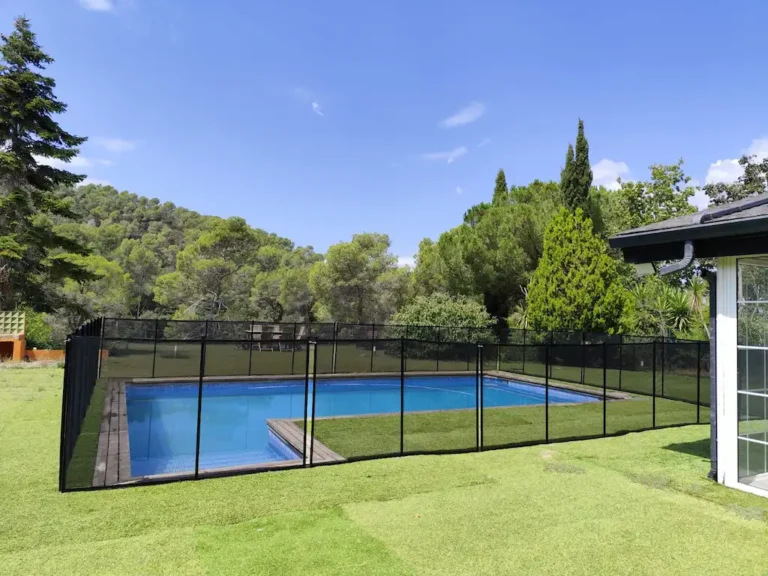


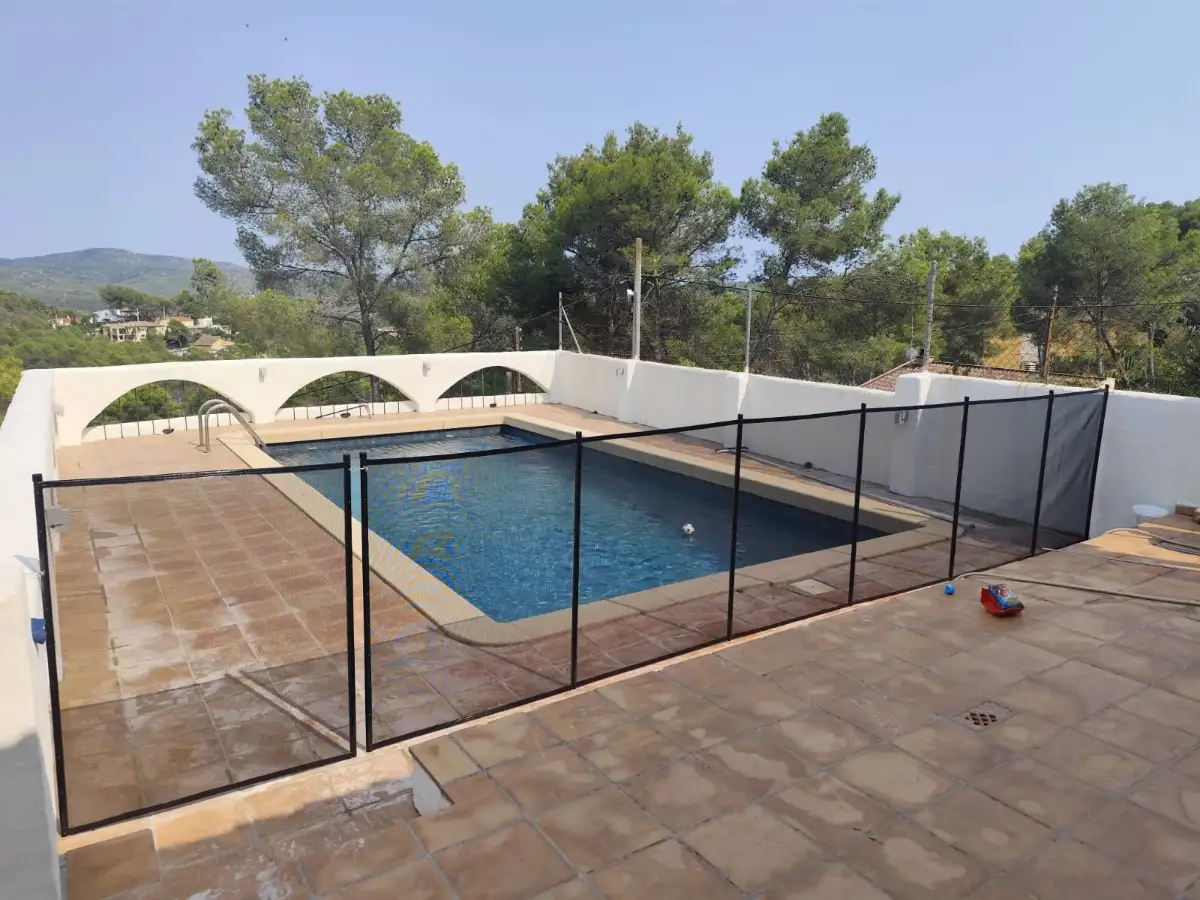
You've decided to protect your pool, and now you're facing the question almost every family asks us: should I add a gate or not? Here's the short answer: in a home with young children, we usually recommend a fence without a gate, because it's more affordable and doesn't rely on someone checking every time that it has been properly closed. A gate pays off in busy, supervised pools, such as hotels, residential communities or holiday rentals.
That said, every pool is different. Both options do the same job as any pool safety fence: create a physical barrier that keeps little ones away from the water when no adult is around. What changes is convenience, everyday use and budget. We'll share everything we see in our installations so you can choose with peace of mind.
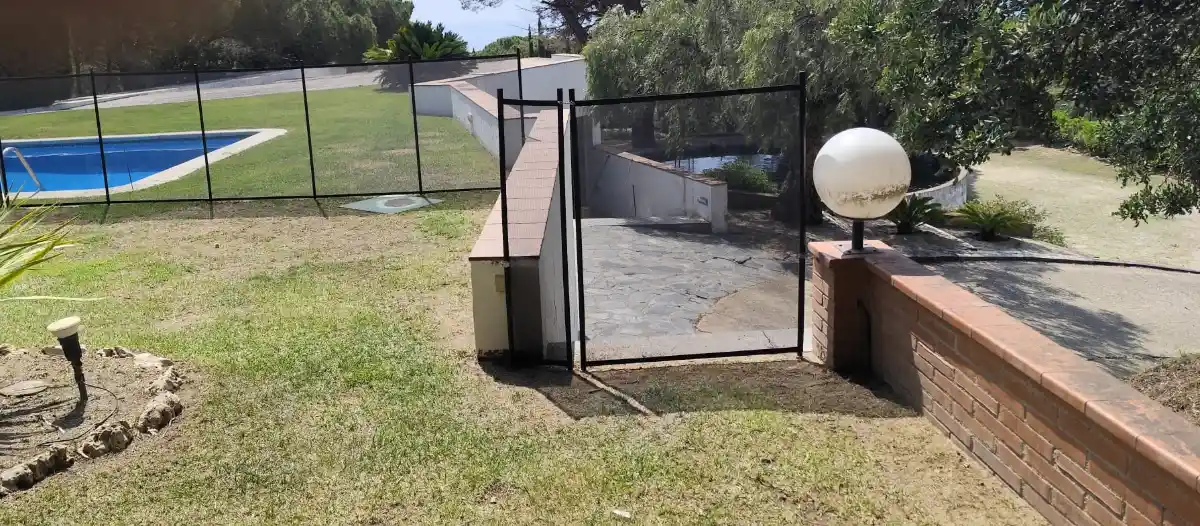
What's the difference between a pool fence with a gate and one without?
It all comes down to how you get in and out of the pool area:
- Pool fence with a gate: it has a fixed access point, a rigid-frame gate built into the enclosure. You walk in and out without touching the fence.
- Pool fence without a gate: the perimeter is fully closed. To get in, you open the safety carabiner on one of the sections and lift its post. That way, any section can become an entry point whenever you need it.
Both protect. The difference lies in convenience and in a detail almost nobody considers at first: how much safety depends on us remembering to close it properly.
How a pool fence with a gate works
How does the gate open and close?
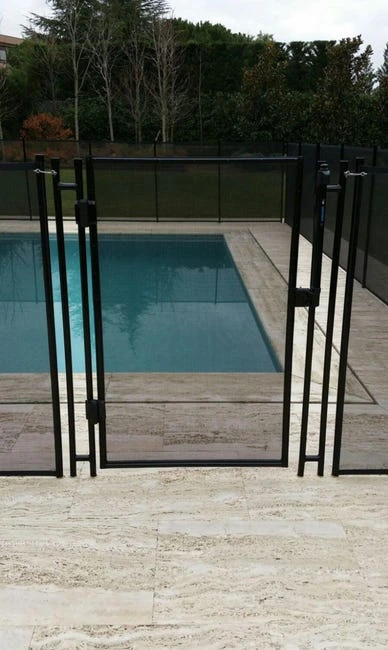
Many people call them “automatic gates”, but there's nothing automatic about them. They are rigid-frame gates with a spring hinge and a magnet that acts as the latch. You walk through, let go of the gate, the spring swings it back into place and the magnet keeps it closed. It's built into the fence and keeps the same safety features as the rest of the installation.
Can a child open it?
The opening mechanism is designed to be operated by adults, not young children. But here's an honest tip, the kind we give on every visit: the weak point isn't the gate, it's us. How often do you stop to check that a gate has closed properly behind you? A towel, a sun lounger or a phone call at the worst moment can leave it ajar, and at that instant the fence stops protecting.
Where should it go?
Along the natural path to the water: next to the house exit, the porch or the sun lounger area. That way everyone uses the same entrance and nobody looks for “shortcuts” through other parts of the fence.
How a pool fence without a gate works
Here you have as many possible entry points as the fence has sections, and you only use the ones that suit you. To get in, you open the safety carabiner, which takes both hands, and lift the section's post. It's a simple move for an adult and one a young child can't manage.
Our removable pool fence is designed for exactly that: open, walk through and put the section back in a few seconds, with the perimeter protected again. And when the season ends or you no longer need it, you remove it completely.
Does it seem less convenient? At first, perhaps. But in private homes it is, in our experience, the most reliable option: closing the section is part of the very act of going in or out, so it's very hard to leave it open without noticing.
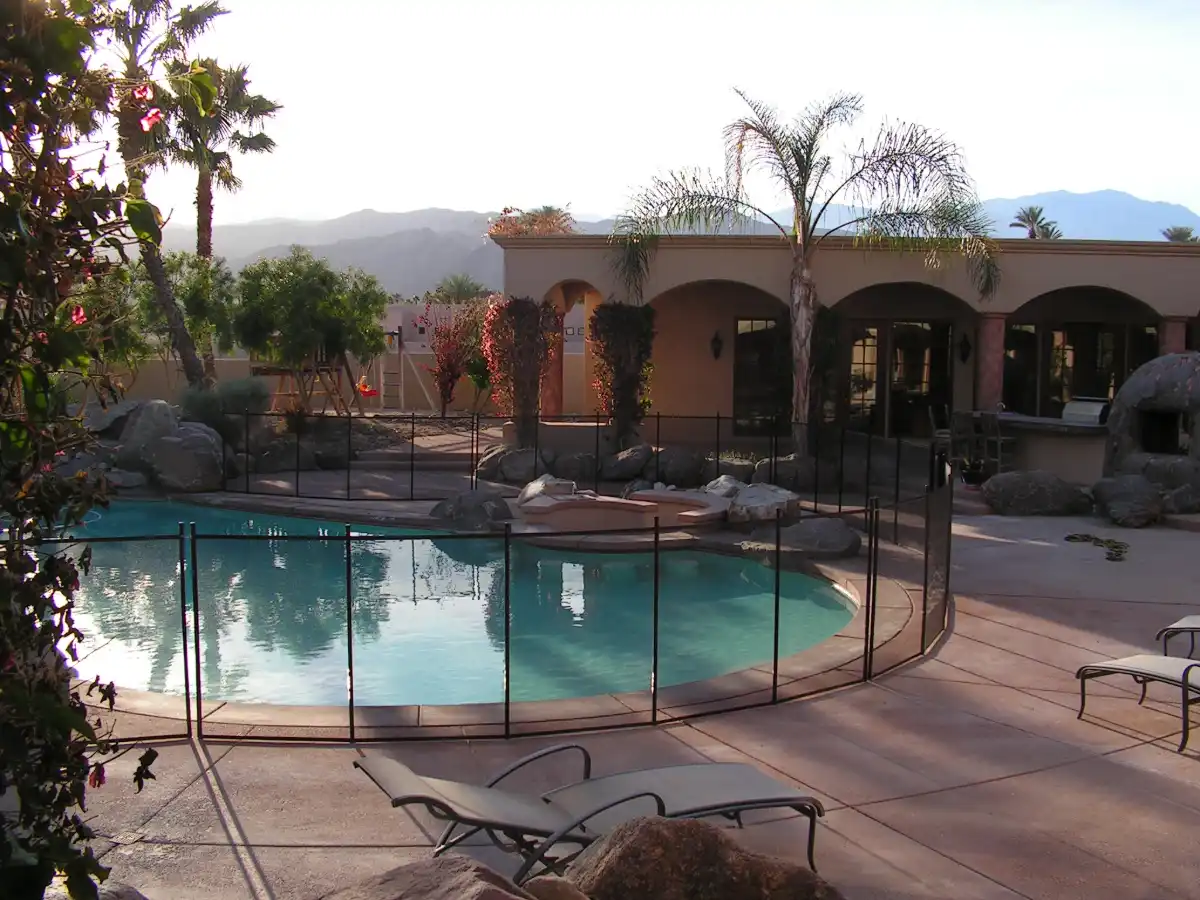
Is a fence with a gate as safe as one without?
It's the big question, and the answer is reassuring: both offer a high level of protection if they're properly installed and used correctly. Safety doesn't depend only on having a gate or not, but on all of this:
- The height of the fence and the colour of the mesh.
- The strength of the materials.
- The ground anchoring system.
- Correct installation around the whole pool.
- Maintenance of the enclosure.
- Responsible use by adults.
And, of course, no fence replaces an adult's watchful eye. If you'd like to know more, we cover it in our guide to child safety at the pool.
Pros and cons of each option
| With a gate | Without a gate | |
|---|---|---|
| Everyday convenience | Walk in and out without touching the fence | Open the carabiner and lift a post |
| Child safety | High, if the latch is checked | High, closing is part of the routine |
| Daily or heavy use | Ideal for frequent access with supervision | Ideal for family use |
| Appearance | Visible rigid frame | Continuous, uniform perimeter |
| Price | €300–400 more | More affordable |
| Maintenance | Check spring and latch | Check carabiners and anchors |
In short: the gate wins on convenience when lots of people come and go, and the fence without a gate wins on price and peace of mind at home, because it doesn't depend on remembering to check the latch.
4 questions to help you decide
Before choosing, try this quick exercise. Answer these four questions honestly and you'll see the decision becomes clear on its own.
How often will you use the pool?
If you go in and out several times a day all summer long, you'll appreciate the convenience of a gate. If the pool is only used now and then, opening a section is no hassle at all.
Will you have time to check that the gate is properly closed?
With young children at home, time flies and attention comes and goes. A second's distraction, a gate that hasn't quite latched, is all it takes for the fence to stop protecting. If you think this could happen to you, a fence without a gate will give you more peace of mind.
What's the space around the pool like?
The shape of the garden, the access points from the house and the type of ground all influence where a gate makes sense and whether a continuous perimeter fits better.
What budget do you have in mind?
Both options protect, but a gate makes the installation more expensive. If you want to keep costs down without compromising on safety, a fence without a gate is the most sensible choice.
When do we recommend adding a gate?
- Heavily used, supervised pools: hotels, campsites or sports centres.
- Residential communities, with neighbours coming and going all day.
- Country houses and holiday apartments, with guests changing every week.
- Older people or those with reduced mobility who need easy access.
- Areas you need to enter often for cleaning or maintenance.
If one of these sounds like you, you'll want to see how we work in residential communities, hotels and holiday rentals.
When is a pool fence without a gate the better choice?
- Family homes with young children, which is the most common case.
- Second homes or pools used occasionally.
- When you want to keep the budget down without giving up on safety.
- Gardens with specific layouts where a continuous perimeter fits better.
- Families who'd rather not depend on checking whether a gate has closed.
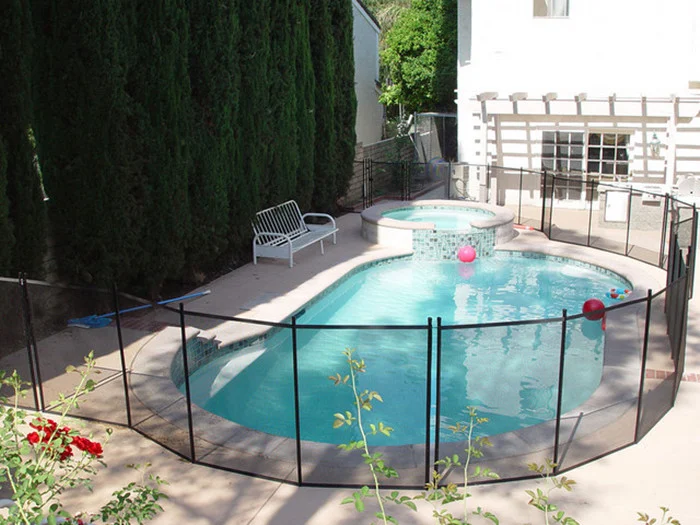
How much does it cost to add a gate to the fence?
As a guide, a pool fence gate usually adds €300 to €400 compared with the same installation without a gate. The final price depends on the length of the perimeter, the shape of the pool, the type of ground (grass, stone, wood…) and whether our team installs it or you fit it yourself with our kit.
Since every fence is made to measure, the best way to find out is to tell us about your pool. In the meantime, you can get some inspiration from our real installations.
Frequently asked questions about pool fence gates
Does the fence gate close by itself?
Yes. It has a spring hinge that swings it back into position and a magnet that keeps it closed. Even so, it's worth checking every time that it has closed properly, because any object or an awkward push can leave it ajar.
Can a child open the fence gate?
The gate's safety latch is designed to be operated by adults, not young children. The weak point isn't the latch, but the gate being left not quite closed without anyone noticing.
Can a child open a fence without a gate?
Not easily. To open a section you have to release the safety carabiner, which takes both hands, and lift the post. It's a move designed for adults that a young child can't manage.
How much more does a pool fence with a gate cost?
As a rough guide, the gate usually adds €300 to €400 to the quote. The total depends on the length of fence, the shape of the pool, the type of ground and the type of installation.
Does a pool fence have to have a gate by law?
It depends on the regulations of each Spanish region and each municipality, especially for shared pools. In private homes, the decision usually depends on how you use the pool. We'll explain it in detail in our upcoming article on regulations.
With or without a gate? We'll help you decide
There's no single answer, and that's good news: it means your fence can be tailored exactly to the way you enjoy your pool. At SafetyKids we make every fence to measure in Alella (Barcelona), install it anywhere in Spain or send it to you ready to fit, and we're with you from your very first question.
Tell us about your pool and who uses it, and we'll tell you honestly which option suits you. No obligation and no small print.